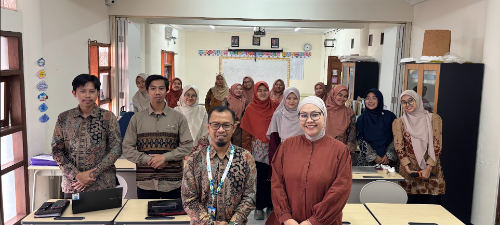
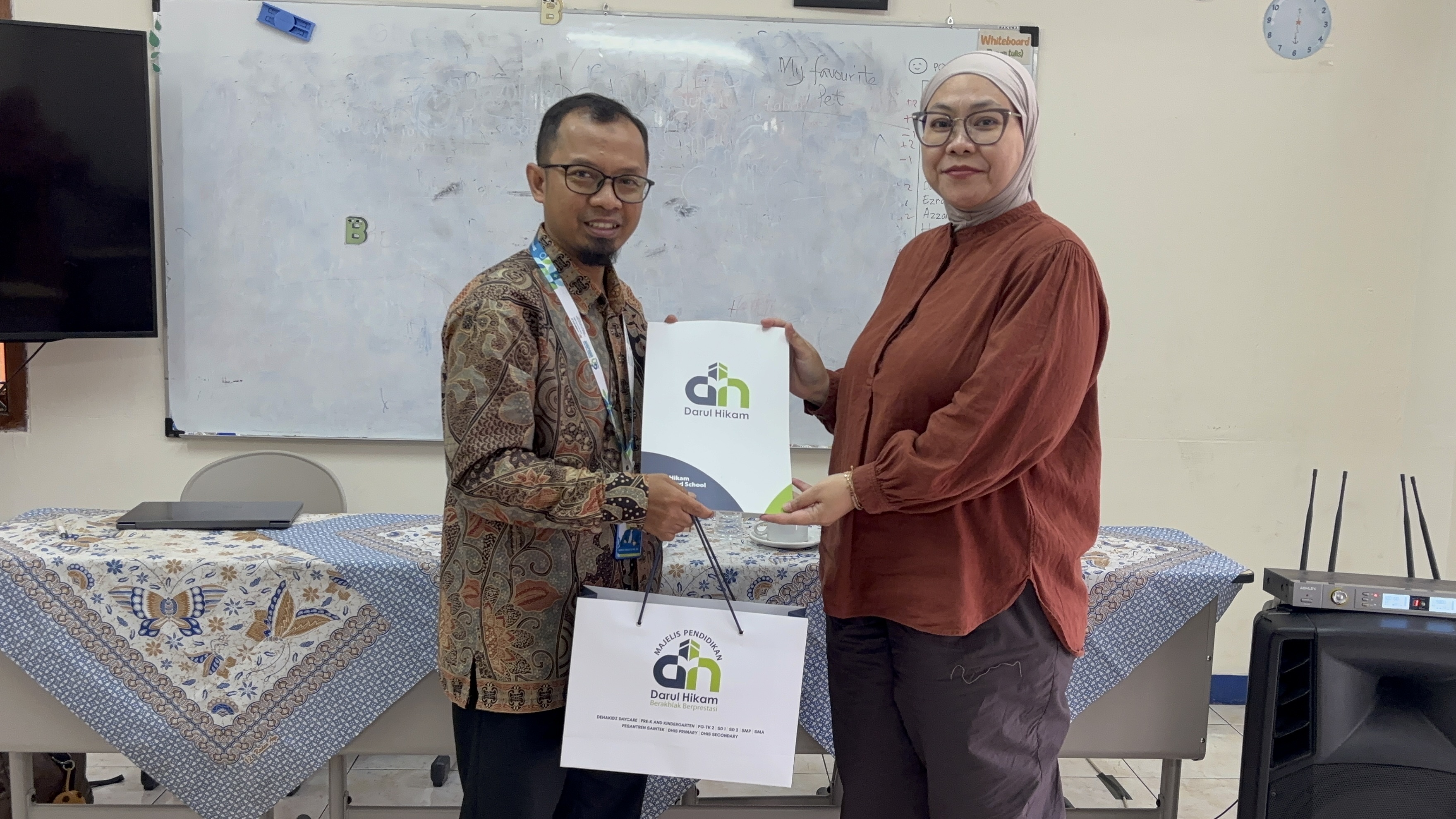
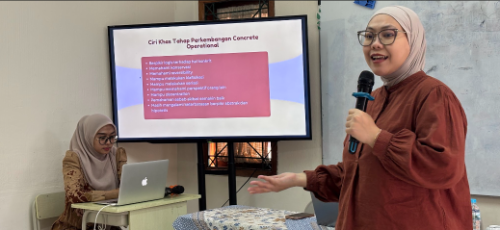
Bandung, 28 August 2026 — As part of our ongoing commitment to strengthening the quality of learning at DHIS Primary Buah Batu, we held an In-House Training (IHT) for our teachers on Friday, 28 August 2026. The training focused on “Desain Pengajaran Aplikatif Berbasis Tahapan Fitrah & Psikologi Perkembangan Siswa SD”, facilitated by Dr. Indri Utami Sumaryanti, M.Psi., Psikolog.
As teachers, we believe that effective teaching begins with understanding how children think, learn, communicate, and develop. The session encouraged us to reflect on how our everyday classroom communication and instructional strategies can be better aligned with the developmental characteristics of primary school students.
Understanding Children Through Their Developmental Stage
One of the key discussions was the Concrete Operational Stage, based on Piaget's theory of cognitive development. Children around the age of 7–11 are increasingly able to think logically, particularly when learning is connected to concrete objects, events, examples, and experiences. At the same time, they may still find abstract and hypothetical thinking challenging.
This understanding reminds us that teaching primary students is not simply about delivering information. We need to make learning concrete, structured, sequential, and observable.
The training also highlighted several characteristics of children's fitrah at the primary school stage, including their natural tendency to be active and curious, enjoy social interaction and group activities, appreciate clear and fair rules, engage in play and imagination, and explore their interests and identity.
Rethinking the Way We Give Instructions
As teachers, we often assume that an instruction is clear simply because we understand what we mean. However, the session reminded us that instructional communication is part of the learning process itself.
Rather than giving abstract or lengthy instructions, we can break them down into shorter, observable steps. The principle introduced in the training was:
Concrete → Short → Sequential → Observable.
We were also introduced to the “Say → Show → Check → Do” approach. Instead of simply asking students, “Do you understand?”, teachers can provide an example, check students' understanding by asking them to repeat the task, and then allow them to begin working.
For us, this was an important reminder: clear teaching is not only about what we say, but also about how we make sure our students understand it.
Supporting Students Through Scaffolding
Another valuable takeaway was the importance of scaffolding. Teachers can provide support according to each student's current ability and gradually reduce that support as students become more independent.
The process can move from:
Modeling → Prompting → Guiding Questions → Independent Performance.
This approach encourages us to move beyond simply telling students what to do. Instead, we guide them to think, make connections, and eventually solve problems independently.
Learning Through Doing, Seeing, and Understanding
The training also introduced Bruner's Modes of Representation: Enactive → Iconic → Symbolic, or simply:
Doing → Seeing → Understanding symbols and language.
This principle is highly relevant to primary education. Students can benefit from experiencing or manipulating something first, seeing its representation, and only then connecting it to abstract symbols or terminology.
This reinforces our commitment at DHIS Primary Buah Batu to create learning experiences that are active, meaningful, and connected to students' experiences.
Building Warm and Positive Teacher-Student Communication
Beyond instructional techniques, we also reflected on the role of teacher immediacy—the ways teachers can reduce psychological distance with students through eye contact, using students' names, responsive facial expressions, warm tones of voice, and meaningful responses to students' answers.
We were reminded that being warm does not mean being permissive. Teachers can remain warm while maintaining clear structures and boundaries.
The way teachers respond to mistakes also matters. Rather than immediately labeling an answer as wrong, we can guide students to revisit their thinking and find the next step.
From Rules to Positive Behaviour
The session also connected classroom management with Positive Behavior Support (PBIS). Expected behaviours should not simply be demanded; they need to be taught, modeled, practiced, and reinforced.
For example, instead of simply saying “Don't be noisy,” teachers can clearly teach students what appropriate behaviour looks like, such as using an appropriate voice level or waiting for their turn to speak.
Growing Together as Educators
For us, this IHT was more than a professional development session. It was an opportunity to pause, reflect, and look again at the small things we do every day in our classrooms—from the words we choose, the instructions we give, and the way we respond to mistakes, to how we build independence and positive behaviour.
As teachers at DHIS Primary Buah Batu, we are committed to continuously learning and improving so that our teaching can meet children where they are developmentally, while helping them grow into confident, independent, curious, and responsible learners.
Because understanding the child is where meaningful teaching begins.